Uganda Peace Bond
By Leland Weiser & Beyza Kaya
Executive Summary
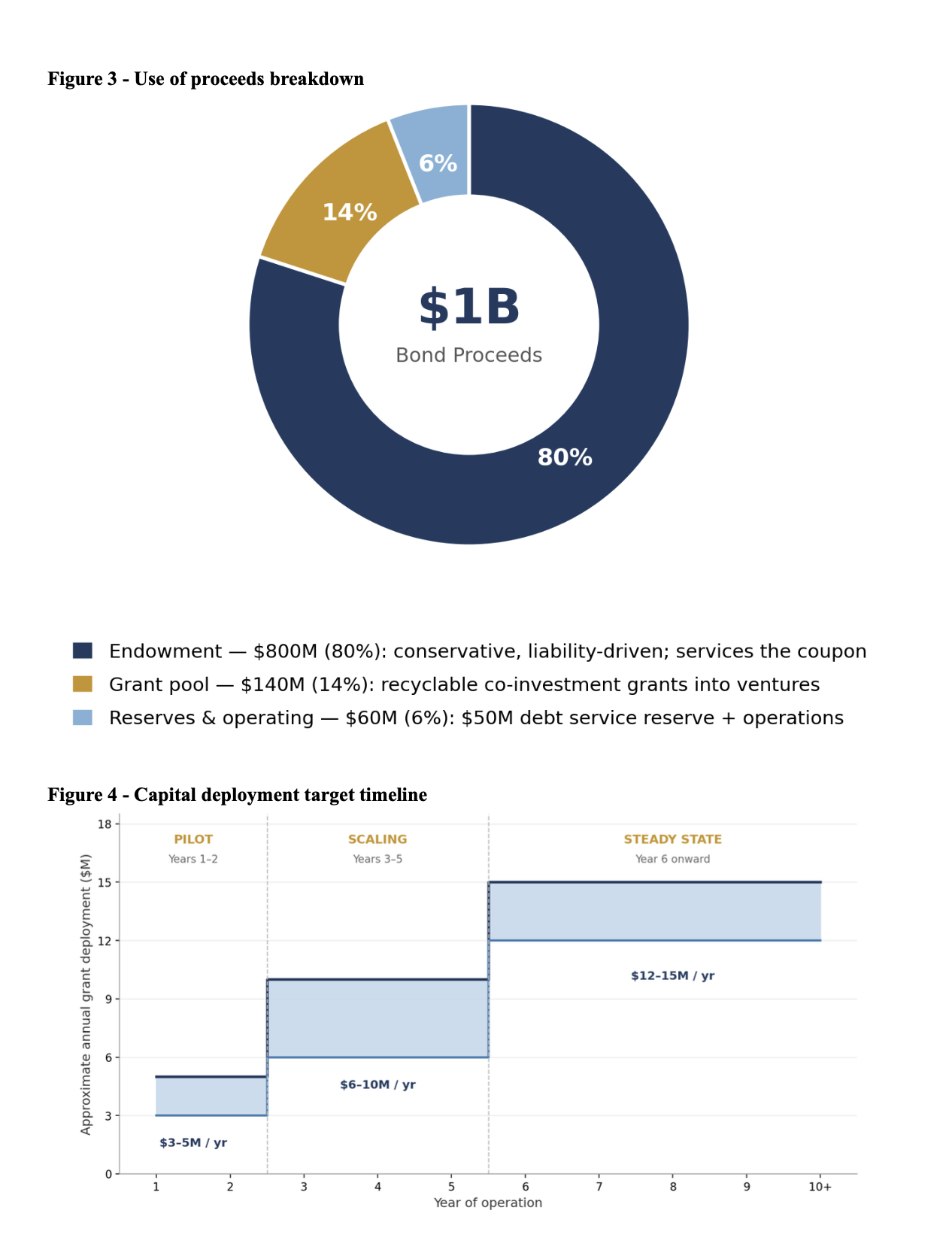
The Uganda–Vietnam Investment Cooperation Foundation (UVICF) proposes a $1 billion, 22-year, USD-denominated peace bond carrying a 5% annual coupon. The bond capitalizes a binational fund that deploys recoverable co-investment grants into joint Vietnamese–Ugandan ventures in Uganda across coffee, aquaculture, light manufacturing, and mining, sectors where Uganda has clear strengths but lacks the capital and expertise to capture their value. The structure has three parts. Most proceeds fund a conservative endowment that services the coupon. A smaller recyclable grant pool drives the development mission. Lastly, a reserve equal to one full year of coupon payments backstops the bond against any shortfall. Bondholders are repaid from professionally managed assets, not the success of any single venture.
Uganda is a fast-growing economy that exports its resources raw and captures little of their value, held back not by a lack of potential but by a lack of capital and technical capability. UVICF closes that gap by pairing Ugandan ventures with Vietnamese partners who supply the processing and operational know-how Uganda lacks, financing them through grants that take no equity and are recovered through royalties, so businesses grow without the burden of debt.
For investors, the bond is built to be safe despite Uganda's low credit rating. Political risk insurance from the Multilateral Investment Guarantee Agency and first-loss credit support from the International Development Association lift it well above Uganda's standalone B-/B/B3 rating, and a roughly 20% cornerstone commitment split between the International Finance Corporation and the African Development Bank anchors the offering. The coupon is paid semi-annually, and the principal is repaid through refinancing at maturity.
Bond Structure:
In June 2026, the Redesigning Finance students presented their work to a panel of experts working in the finance, NGO, and legal sectors.