Poland Peace Bond
By Joaquin Abarca and Travis Hodges
Executive Summary
The proposed Poland Peace Bond is a $1 billion-equivalent, 12-year sovereign-linked investment vehicle designed to finance the conditions that make peace durable: energy security, productive employment, credible institutions, and an innovation system capable of converting talent into high-value firms. Poland is not a fragile economy. It is one of the largest economies in Central and Eastern Europe, deeply integrated with the European Union and NATO, and the World Bank describes it as a resilient, diversified, open economy that must now pursue next-generation reforms to continue converging toward richer EU peers. The Peace Bond is therefore a modernization bond rather than a rescue bond: it uses disciplined capital to deepen Poland's economic security, reduce execution bottlenecks, and strengthen the systems that make long-run stability more investable.
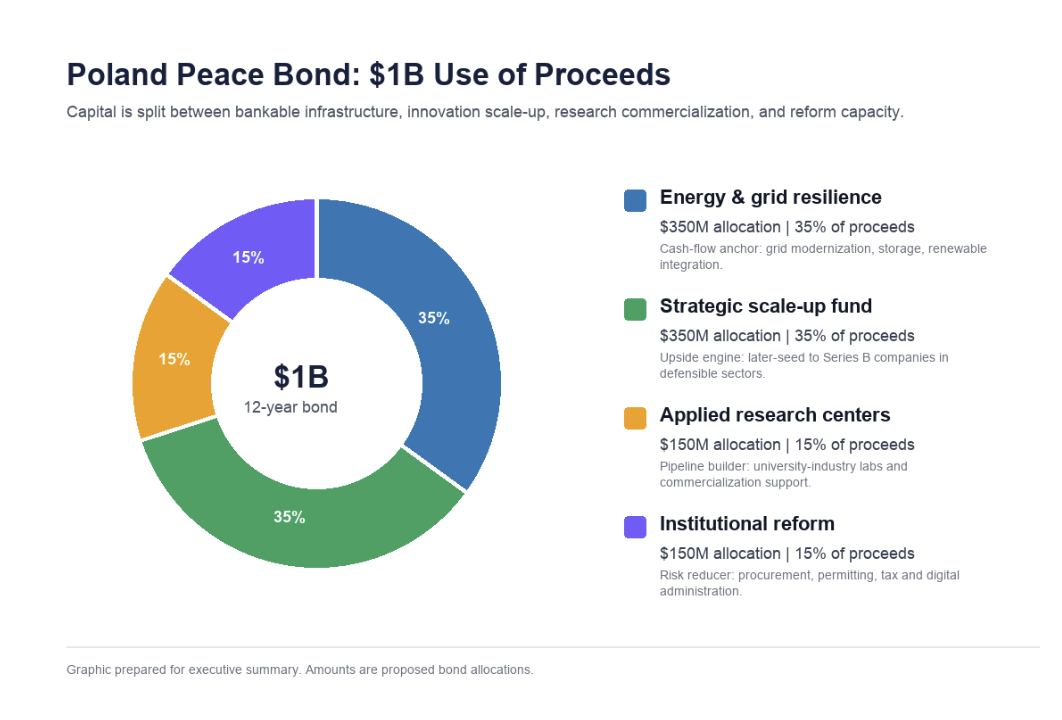
The investment thesis behind the bond is that Poland’s primary peace and growth risks are not a lack of basic industrial capacity, but rather bottlenecks in the systems that support this capacity and provide long-term resilience. Current economic readings support this belief. WIPO’s Global Innovation Index 2025 ranks Poland 39th overall, with an output rank of 36 and input rank of 45. In other words, Poland produces globally competitive innovation outputs from a weaker input base, suggesting that improvements to capital markets, research commercialization, grid infrastructure, and institutional reforms can have outsized economic returns. This bond targets this input/output gap. The bond is therefore structured around four uses of proceeds: a Strategic Scale-Up Fund, Applied Research Centers, Energy and Grid Resilience, and Institutional and Regulatory Reform.
Bond Structure:
In June 2026, the Redesigning Finance students presented their work to a panel of experts working in the finance, NGO, and legal sectors.