Argentina Peace Bond
By Dilan Desir and Eleanor Facey
Executive Summary
Argentina is the second largest economy in South America and the eighth largest country in the world by landmass. It holds the world’s second largest shale gas reserves and fourth largest shale oil reserves. Its agricultural output feeds roughly 400 million people globally. By any conventional measures of national stability, it performs well, currently ranked ahead of the United States and France on the Global Peace Index. Despite these positive forces, its sovereign credit rating is a CCC+, a consequence of a state that has consistently spent beyond its productive capacity, financing the difference(s) by printing money.
Importantly, the nation has defaulted on its sovereign debt nine times since its independence. Each default followed the same broad pattern. The government would first spend beyond its existing tax revenues, then finance the gap through central bank money printing, triggering inflation, losing access to external credit markets, and finally restructuring the resulting debt without ever closing the initial fiscal gap that produced it. The 1992 Brady Bond restructuring converted default commercial bank loans into tradeable securities but did not change the fundamental issue of Argentina’s problematic approaches to spending.
Every restructuring adds a layer of complexity to Argentina’s liability stack. They further act as risk signals to future creditors and push yields higher on subsequent issuances. Higher yields increase debt servicing costs, which widen the fiscal gap, which increases the pressure to print more. The CCC+ rating is a readout of the aforementioned loops, priced into every basis point Argentina pays above investment grade peers.
The loop ultimately suppresses the real economy because as sovereign yields become elevated, domestic borrowing costs for businesses skyrockets. Capital-intensive industries cannot access affordable financing which creates stronger motivation for entrepreneurs and skilled workers to operate in dollar-stable economies. Buenos Aires has a deep base of talent and a functioning innovation ecosystem, but decades of poor management have led to continued exports of talent. This bond, therefore, is premised on fixing the underlying imbalance within the sovereign which does not rely on the same complex financial engineering of the past.
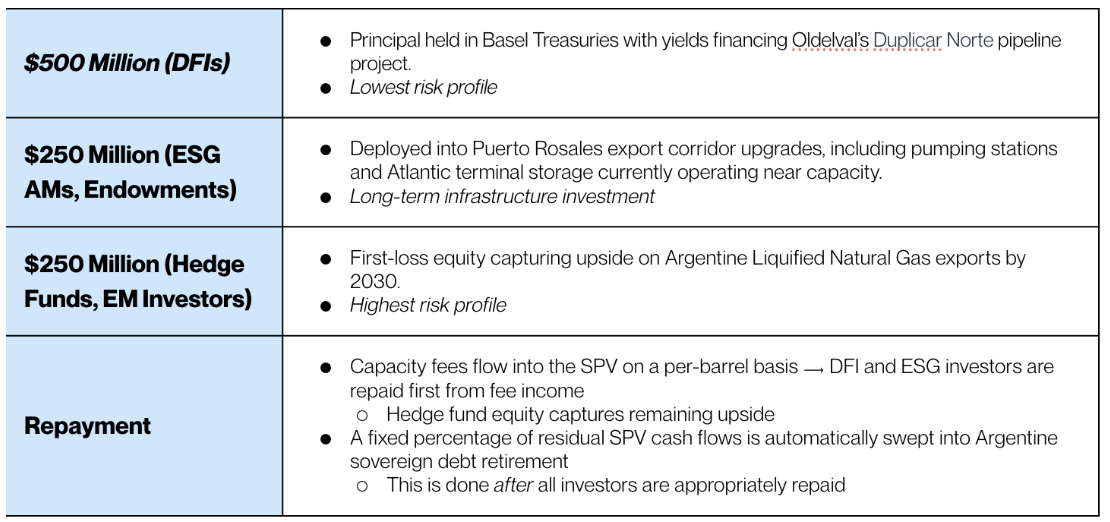
Bond Structure:
In June 2026, the Redesigning Finance students presented their work to a panel of experts working in the finance, NGO, and legal sectors.